DESIGN
FOR PEOPLE DESIGN FOR COMMUNITY
- 2
DESIGN CHALLENGES
- 6
FINALISTS PER CHALLENGE
- S$10K
GRAND WINNER PRIZE
Pick Your Challenge
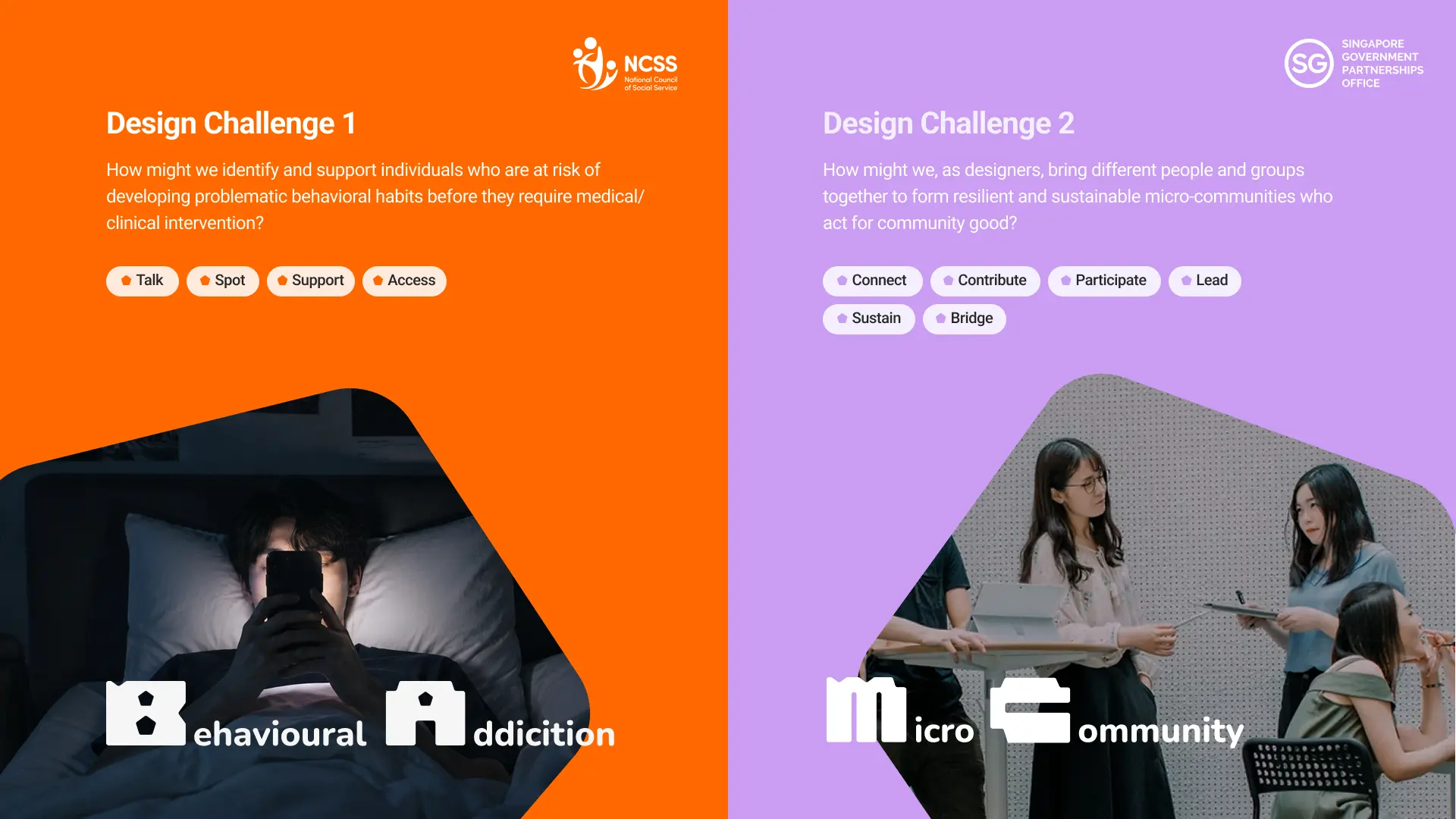
Design Challenge 1
Core Issue
Behavioural habits such as gaming, social media use, gambling and pornography can become problematic when they are difficult to control and begin affecting wellbeing, relationships and everyday life.

Key insight
Look beyond the behaviour. The behaviour may fullfil a deeper need such as belonging, identity, stress relief or coping.
Possible design territories

Spot Recognising early signs that a behaviour may be becoming problematic

Talk Creating safe opportunities for people to open up about their behaviour and what may be behind it

Support Providing practical and emotional support before the situation escalates

Access Making the right help easier to find, understand and reach
What designers could explore
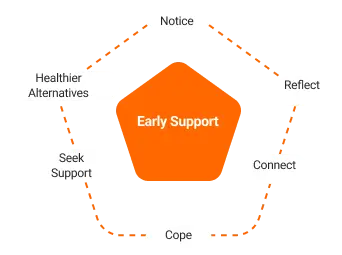
Products, services, digital tools, environments, experiences, campaigns, community interventions or systems that support early identification, prevention and help-seeking.
- Products
- Services
- Digital Tools
- Environments
- Experiences
- Campaigns
- Community Interventions
- Systems
Important consideration
The focus is preventive, not medical or clinical treatment.
Design Challenge 2
Core Issue
People may live alongside one another without developing meaningful relationships or a sense of shared responsibility. Micro-communities can create opportunities for people to connect, contribute and act together, thereby serving as a locus for the deepening of relational trust, sustained participation in community life, and the nurturing of community leaders.

Key insight
People often form stronger relationships because they have something meaningful to do together, rather than because they were told to “build community”. Relationships grow through doing together because people practise affirming one another’s gifts, being considerate of one another’s needs, navigating misunderstandings and disagreements, and sharing responsibilities.
Possible design territories

Connect Bring people with different backgrounds together through shared tasks that build interdependence and trust over time

Contribute Recognise members through their strengths and allow roles to shift between giving and receiving support

Participate Anchor the community around a recurring shared practice that gives people a concrete reason to return

Lead Create a pathway from participation to leadership so responsibility is not held by one person alone

Sustain Build in predictable rhythm, reflection and proportionate safeguards so the community can adapt without losing its purpose

Bridge Connect micro-communities with wider organisations and support so they stay resilient, without becoming closed off from the people and resources around them
What designers could explore
Programmes, platforms, placemaking, community initiatives, experiences or systems that:
- Activate people to participate, contribute, and take collective action for community good
- Help them build resilient relationships in so doing.
Important consideration
A shared purpose or practice gives people a reason to return. Co-creation and co-delivery are essential for creating a shared stake in the continuity of a micro-community. One-off attendance is not enough.
Seed Money
The award quantum takes into account the time and effort put in by participants; it serves as a guide for participants to define and specify their deliverables. The buffer between the 2 levels of seed money is to distinguish the merits for every solution in terms of their intensity/complexity and completeness to the solution.
up to

up to

Important Dates

Terms & Conditions
Eligibility
- All entries submitted must be completed or realisable within the 6 to 12 months timeline, with a minimum viable product (MVP) following proof of concept
- Joint-project submissions from more than one design firm or practice are eligible for entry.
- Conceptual works and projects developed by students who are still undergoing professional design studies are eligible.
- Any projects submitted which have not conformed to the Terms & Conditions are not deemed eligible.
- The executive committee in consultation with the international judges reserves the right to reject entries on the grounds of ineligibility if they affect the standards of the awards, potentially mar the reputation of the organisation and its jury, cause any concern on the issue of interests, etc.
Intellectual Property, Rights & Terms of Use
- All rights related to the name and trademark of Singapore Design Awards are managed and owned exclusively by Design Business Chamber Singapore.
- Any candidate seeking to use the related name and trademark must obtain written consent from the DBCS Executive Committee.
- Awardees are permitted to use the relevant Singapore Design Awards logos.
- Design companies or designers submitting works for any category must be responsible for their own intellectual property (IP) and patent issues. The organisers take no responsibility for any infringement of IP rights.
- All design firms and institutions submitting an entry to the Singapore Design Awards agree to allow the organisers to use and reproduce their submissions for publicity purposes.
- If any press, publications or media networks agree to publicise the awardees, the entrants agree to absorb any talent or other residual charges incurred by inclusion, if required.
- All finalists of Singapore Design Awards agree to grant the National Council of Social Service (NCSS), the Ministry of Culture, Community & Youth (MCCY), and their affiliates and authorised representatives, an irrevocable, perpetual, non-exclusive, worldwide, royalty free, and fully-paid up licence. This licence allows NCSS, MCCY, and their affiliates and authorised representatives to use, copy, modify, reproduce, create derivative works, sublicense, and distribute the Awardee’s intellectual property rights (IPR) for non-commercial and/or educational purposes only. The complete seed funding agreement for NCSS is available for viewing here. Finalists of SGPO’s challenge statement will be notified separately of the terms and conditions of seed funding from the SG Partnerships Fund, and are strongly advised to take note of funding caps and project expenses that can or cannot be covered by reviewing the FAQs.
Judging
- The judges reserve the right not to confer awards in any category if the entries were found to be below par in terms of reaching the top bandwidth of a category’s score board.
- The judges’ decisions are made with their own discretion and are considered final.
- All submissions will be evaluated by the same panel of judges from each discipline.
- Should the judge be involved in any of the entries submitted, he/she will not be allowed to evaluate the project.